COUNTER THREAT LABS™ · HUMAN–CYBER ANALYSIS
PSYBER FUSION™
Cyber activity is only part of the picture.
Technical events develop inside human and organizational environments.
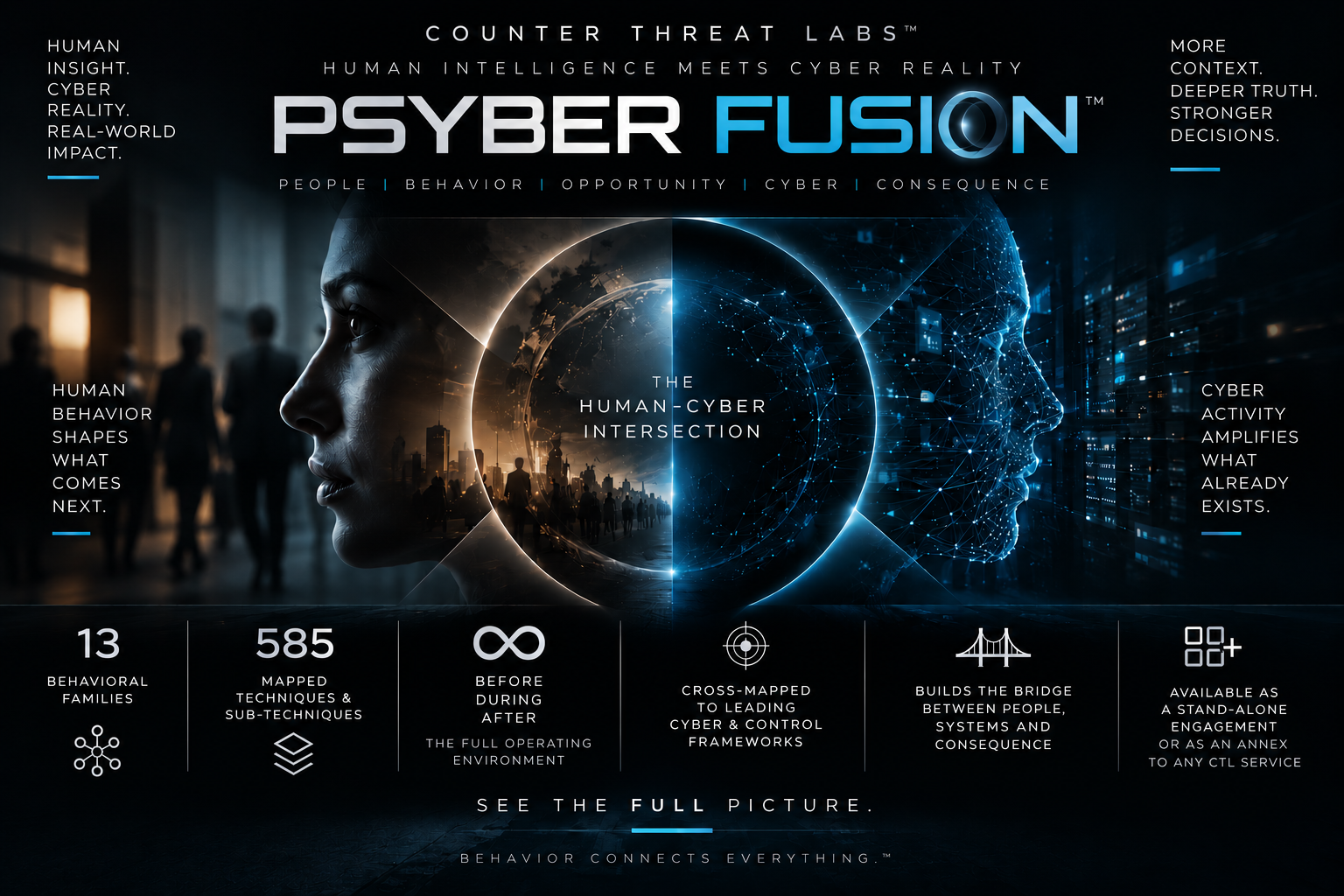
PSYBER FUSION™ examines high-stakes relationships among human behavior, identity, authority, communication, organizational response, technical activity, cyber conditions, and machine participation before, during, and after material events.
During
AfterMaterial events
HUMAN–CYBER CONDITION
See the relationships that technical evidence alone cannot explain.
Identity, authority, trust, communication, organizational response, technical activity, and machine participation can shape the same complex condition.
PSYBER FUSION™ preserves source identity across human, organizational, technical, and machine evidence. Shared upstream material is not treated as independent corroboration, and contradictions remain visible when the evidence cannot be reconciled.
Crosswalk capability extends into established cyber, AI, defensive, governance, and assurance frameworks where the evidence supports a relevant relationship.
DEPLOYMENT
Independent when required. Integrated when material.
PSYBER FUSION™ may operate independently or alongside another CTL engagement when the human–cyber dimension materially affects the condition.
PROOF BOUNDARY
Behavioral structure does not establish intent.
Behavioral structure does not independently establish intent, attribution, causation, compromise, or adversary identity. Findings remain bounded to the evidence available.
HUMAN–CYBER CONDITION
Bring the Human–Cyber Condition Into View
Begin with the material event and the human, organizational, technical, or machine relationships that may affect its consequence.
Approach PSYBER FUSION™