INFORMATION INTEGRITY
FIELDGLASS™
See the information environment before it shapes the decision.
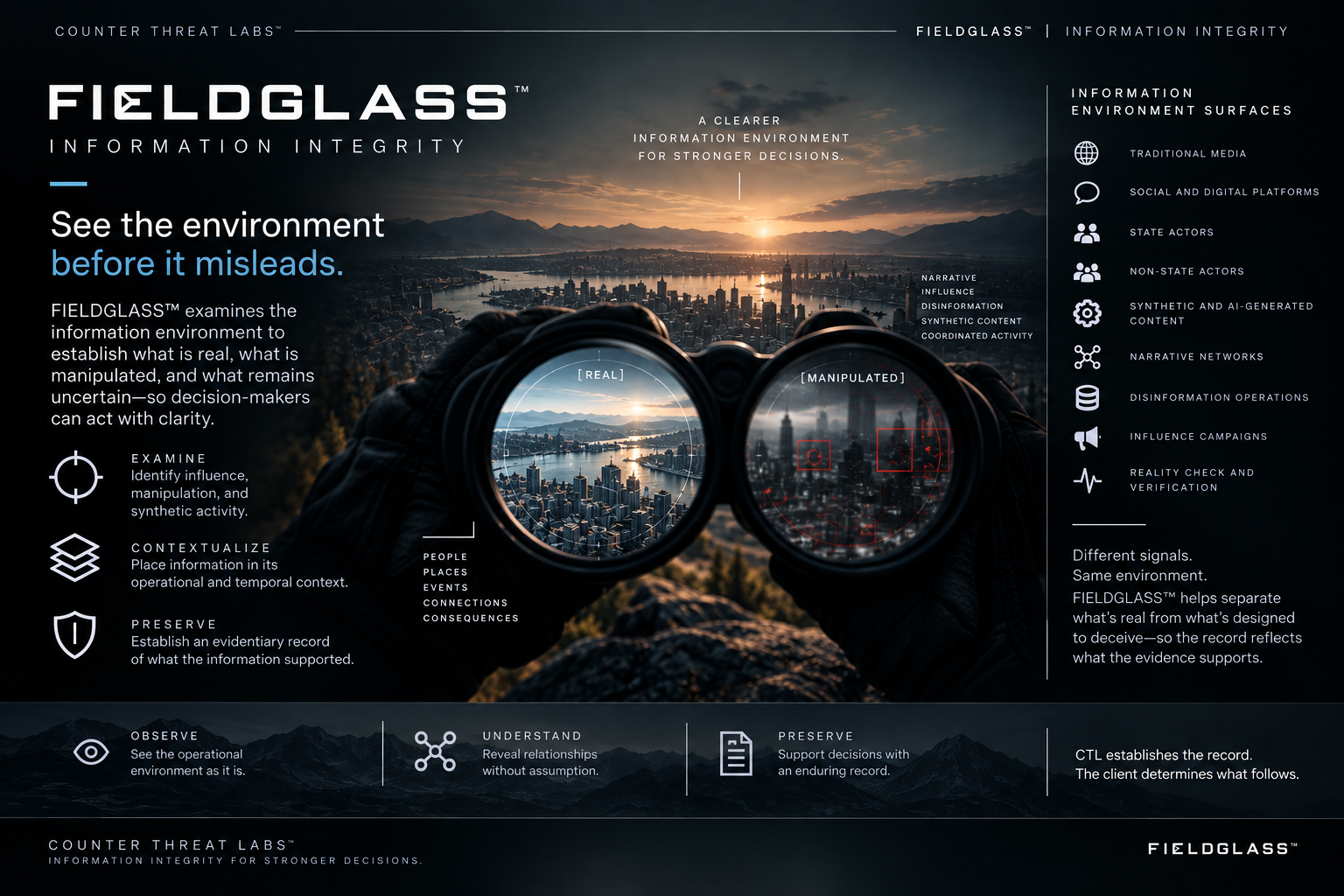
Structure information when claims, sources, records, synthetic material, contradictions, and the surrounding information environment are unstable.
FIELDGLASS™ operates where apparent certainty may exceed what the underlying record can support. It examines what is present, claimed, verified, attributed, unsupported, contradictory, synthetic, or machine-shaped—and whether the surrounding information field has become degraded even when individual items remain usable.
RECORD DISCIPLINE
Repetition does not create independent support.
FIELDGLASS™ distinguishes original support from derivative repetition, copied claims, synthetic material, and shared upstream sources. Repetition does not become independent support merely because it appears across multiple channels.
PUBLIC CAPABILITY SURFACES
Where the capability operates.
Provenance and origin review
Contradiction and ambiguity preservation
Synthetic and machine-shaped material review
Item integrity versus field integrity
Source-echo and convergence review
Correction and update reach
Information-environment degradation
Bounded decision posture
OUTCOME CLASS
What the capability is designed to establish.
A bounded information posture suitable for accountable decision: supported, partially supported, contested, unverified, degraded, or withheld where the structure cannot carry a stronger conclusion.
PUBLIC BOUNDARY
What the capability does not claim.
FIELDGLASS™ is not a fact-checking brand, media-criticism service, persuasion system, ideological judge, or narrative engine. It structures what the available material can and cannot support.
APPROACH PATH
Approach FIELDGLASS™
Initial contact requires only enough information to identify the appropriate next conversation.
Approach FIELDGLASS™